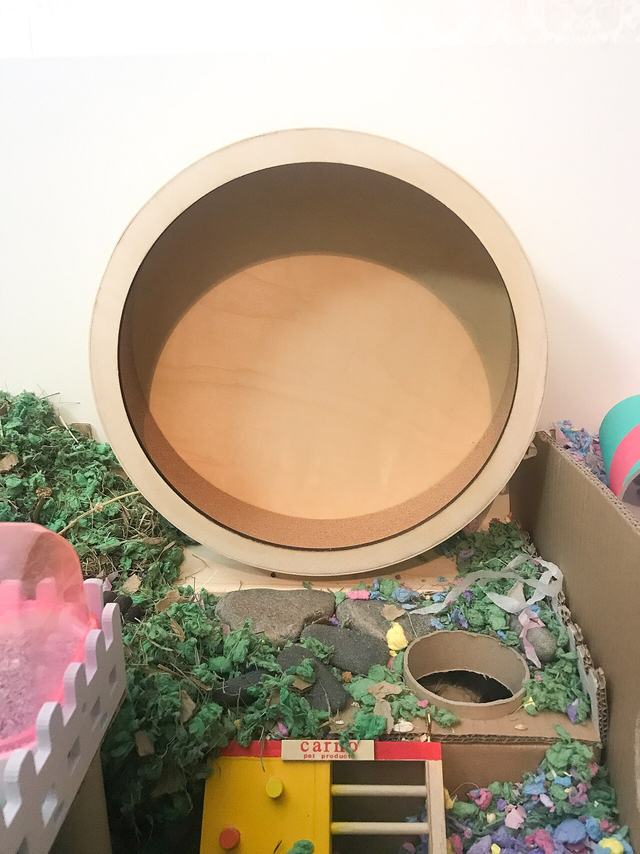
Begin with the hamster's size
Find advice for the species you keep and use the wheel's actual running diameter, not its packaging dimensions. Woodgreen lists an upright wheel of about 30 centimetres for Syrian and Chinese hamsters and about 20 centimetres for other hamsters. Check the current species guidance and the individual animal's posture; ask an experienced rescue or vet if the fit is uncertain.
Look for an upright wheel with a continuous solid running surface. Avoid rungs, mesh, and gaps that can catch a foot. Check the entrance and supports as carefully as the inside track. Product descriptions may highlight quiet bearings while leaving out the dimensions that determine whether the hamster can run with a natural body position.
Measure the installation, not just the wheel
Draw a side view of the habitat with its planned bedding level. Add the total height of the wheel on its stand, including any adjustment range and the clearance required for rotation. Check whether a lid, overhead shelf, or ventilation fitting will interfere. A wheel should not require removing the burrowing area to make it fit.
The base needs stable support. Plan for digging and bedding movement around it, and follow the manufacturer's installation instructions. If a wall mount is offered, verify that it is suitable for your enclosure instead of improvising a fixing through a fragile panel. Keep the wheel reachable so you can remove it for cleaning without disturbing every hide.
Read the maintenance details
Before checkout, locate cleaning instructions and an assembly diagram. Ask how the track detaches, which parts can get wet, and whether replacement components are available. A sealed bearing and a washable running surface are separate features; neither tells you that the entire assembly should be submerged. Save the instructions where another caretaker can find them.
Read negative reviews for recurring, concrete issues such as a loose stand or difficult disassembly, while recognizing that reviews are individual reports rather than controlled tests. Compare those reports with the seller's response and current product design. Do not call a wheel silent, durable, or safe based only on its listing or an attractive demonstration video.
Before discarding the packaging, record the wheel model and the instructions for its stand, axle, and removable parts. Check whether the manufacturer sells replacements and what tools maintenance requires. After reassembly, test the wheel while the hamster is elsewhere safely and confirm that no fastener or cleaning material remains nearby. Keep a note of recurring rubbing or movement of the stand. Those observations can help a seller understand a fault without requiring repeated experiments during the hamster's active period.
Watch use and respond to changes
Observe ordinary use while the hamster is naturally awake. Look at body posture, clearances, slipping, and whether the base shifts. Record a short video from outside the enclosure if the view is difficult; it can help you review the setup without repeatedly approaching the hamster. Recheck after adding fresh bedding or moving other furnishings.
A wheel is one activity within a habitat that also offers burrowing, hiding, and foraging opportunities. Do not use running time as a fitness target or encourage the animal to keep moving. Stop using faulty equipment. If you see a sore foot, altered gait, injury, or a concerning change in activity, contact a vet rather than assuming a different accessory will solve the problem.
Keep it practical
Your checklist
- Compare actual running diameter and total installed height.
- Choose a solid running surface without foot-catching gaps.
- Provide stable support above the burrowing area.
- Save assembly, cleaning, and replacement-part information.
- Watch posture and stability during normal use, and seek care for injuries.
Sources & further reading
Sources offer further context; a link is not an endorsement of this publication. This guide is general information and does not replace care from a vet familiar with your animal.
See our editorial policy and commercial disclosure. Please tell us about an error.